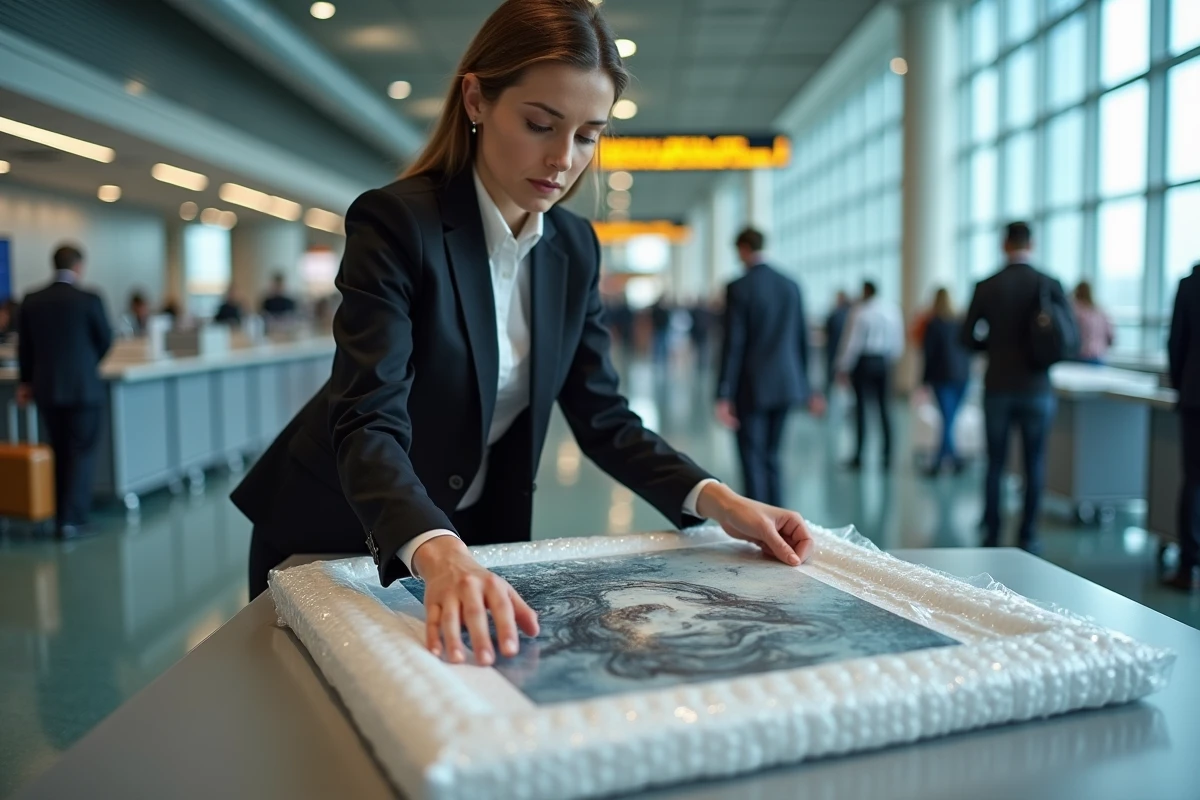
Aviation regulations do not make exceptions for works of art: every centimeter counts, every missing document matters, and approximation has no place. In the cabin, it is better to inquire well in advance as few airlines spontaneously accept a painting, unless there is a waiver or additional fees to consider. Internationally, customs clearance almost always involves an administrative ballet: export certificates, ministerial authorizations, various justifications, everything must be ready, without exception.
A poorly done packaging can sometimes lead to disaster: scratched canvases, cracked frames, blistered varnish… Insurance companies are also serious: the slightest negligence during handling can void coverage. All too often, underestimating the preparation for transport can be very costly, both legally and financially.
What are the main risks when transporting a painting by plane?
Transporting a painting by plane exposes one to a series of rarely detailed perils. The real obstacle course begins even before the flight: without suitable packaging, without a sturdy crate, the slightest weakness can become fatal. A poorly secured canvas endures the jolts of transit, sometimes brutal handling in the hold, and repeated passes through security can further compromise its condition. In terms of protection, nothing replaces thorough preparation.
Temperature and humidity fluctuations on board remain the nightmare of collectors, especially for fragile or old works. On a long-haul flight, the painting endures sometimes violent contrasts: the paint cracks, the wood warps, the varnish fissures. Often, these alterations are only revealed once the piece is hung or restored, making diagnosis more complex.
Each transfer also exposes one to loss or theft. A painting that deviates from the ordinary flow inevitably attracts attention, whether from staff or ill-intentioned individuals. Hence the absolute necessity for precise tracking and comprehensive insurance, from boarding to destination, especially for transport between France and Europe.
Ultimately, the security of transporting a painting by plane relies on meticulous anticipation and flawless documentation. The slightest oversight, the smallest negligence, can leave irreversible scars on the work.
Formalities and regulations: what you must absolutely know before departure
Transporting a work of art out of France, or even to certain European countries, requires mastering customs requirements. Each country applies its own rules regarding the entry and exit of cultural goods: it is better to check before departure if an old painting or a contemporary creation requires an export authorization. This administrative step, much more than a mere formality, conditions the crossing of borders and avoids unpleasant surprises, such as unexpected seizures.
It is highly recommended to have a detailed condition report prepared by a professional or an auctioneer. This document, which accompanies the painting during the journey, protects the owner in case of damage or disputes upon arrival. Add to this: purchase invoice, proof of ownership, authenticity certificate if available. Meticulous preparation eliminates the risks of disputes.
Here are the points not to be neglected to pass through customs smoothly:
- Ensure that the insurance covers the entire journey, from Paris to the final destination.
- Keep all travel documents handy: they will be systematically requested during checks.
A forgotten document can open the door to the retention of the painting or legal complications. Customs does not compromise: every justification must be ready to be presented. For the transport of works of art, administrative rigor remains the best protection against loss, spoliation, or avoidable degradation.

Essential precautions and expert advice to ensure the safety of your work
Packaging: the first line of defense
The choice of the crate and packaging materials makes all the difference for air transport. Professionals recommend a custom wooden crate, strong enough to absorb shocks while limiting temperature and humidity fluctuations. It is crucial to use neutral cushioning materials, free of acidity, to stabilize the work without compressing it. The corners and edges must be particularly well cared for, as these are the most exposed points to impacts.
Before the trip: anticipate every incident
A condition report drafted by an expert is essential before any shipment. This report mentions every detail, every mark, and serves as indisputable proof in case of a problem. Also consider taking dated photographs from multiple angles: they can weigh heavily in case of a claim.
Here are some tips to minimize risks as much as possible:
- The insurance should cover all stages, from pickup by the carrier to final delivery.
- If possible, prefer the cabin to the hold: pressurized compartments reduce the risks of thermal shock and excessive humidity.
Secure transport does not mean overprotecting: too much sealing, and condensation threatens the integrity of the painting. The ideal is to combine insulation and breathability, paying attention to every detail from the construction of the crate to the management of insurance. Whether it is a shipment within Europe or beyond, rigor and composure can sometimes make the difference between a preserved work and a piece forever marked by the journey. It is in the precision of each step that the serenity of the collector finds its best ally.