
A dull brushcutter blade doesn’t cut; it tears. The result is visible on the vegetation (whitened tips, split fibers) and felt on the machine (increased vibrations, higher consumption). Here, we share the technical points that make the difference between proper sharpening and sharpening that is truly suited to your terrain.
Sharpening Angle of the Blade According to the Type of Vegetation
Not all sharpenings are equal, and the cutting angle must correspond to the vegetation being treated. The technical sheets from Oregon and Stihl clearly distinguish between two scenarios.
For tall grass and fine shoots, an open angle produces a sharp edge that cuts cleanly without effort. The blade penetrates the material with little resistance, which reduces engine load and limits overheating.
On brambles, dense undergrowth, or young woody plants, a slightly more blunt angle enhances the durability of the edge. An edge that is too fine chips at the first contact with a woody stem, which forces premature resharpening and unbalances the blade.
We recommend checking how to sharpen a brushcutter blade while considering this distinction, rather than applying a single angle regardless of the job. Adapting the angle to the terrain extends the life of the edge and reduces the number of sharpening passes in the season.

Checking the Balance After Sharpening the Blade
Balancing is the most overlooked point. Removing more material from one side, even by a minimal amount, is enough to create an imbalance that transmits to the drive shaft and then to the engine.
Detecting an Imbalance
The most reliable method is to place the blade on a screwdriver or a conical chuck positioned at the center of the mounting hole. If one side tilts, you need to resharpen the heavier side with very light passes.
In the field, an imbalance manifests as abnormal vibration that appears as soon as the engine revs up. Continuing to work under these conditions accelerates bearing wear and can damage the clutch.
Sharpening with Symmetrical Passes
Count the same number of passes with the file or grinder on each edge. We apply this rule systematically, even when only one side seems dull. The mass difference between the two arms of the blade must remain imperceptible during balancing.
Choosing the Sharpening Tool for Brushcutter Blades
The choice of tool determines the quality of the result and the consistency of the angle. Each method has its limits.
- The flat or half-round file offers total control of the angle. It is suitable for grass knives and blades with two or three teeth, provided a constant angle is maintained throughout the pass.
- The angle grinder with flap disc removes material quickly, but overheating is a real risk. Steel that turns blue loses its temper, and no subsequent sharpening can compensate for this loss of hardness. Work with short passes, without applying pressure, and allow to cool between each pass.
- The belt sharpener or bench grinder with angle guide ensures repeatability. They are relevant for toothed circular blades, where each tooth must receive identical treatment.
For toothed circular blades, we prefer the sharpener with guide, as a deviation of a few degrees from one tooth to another causes noticeable cutting jolts.
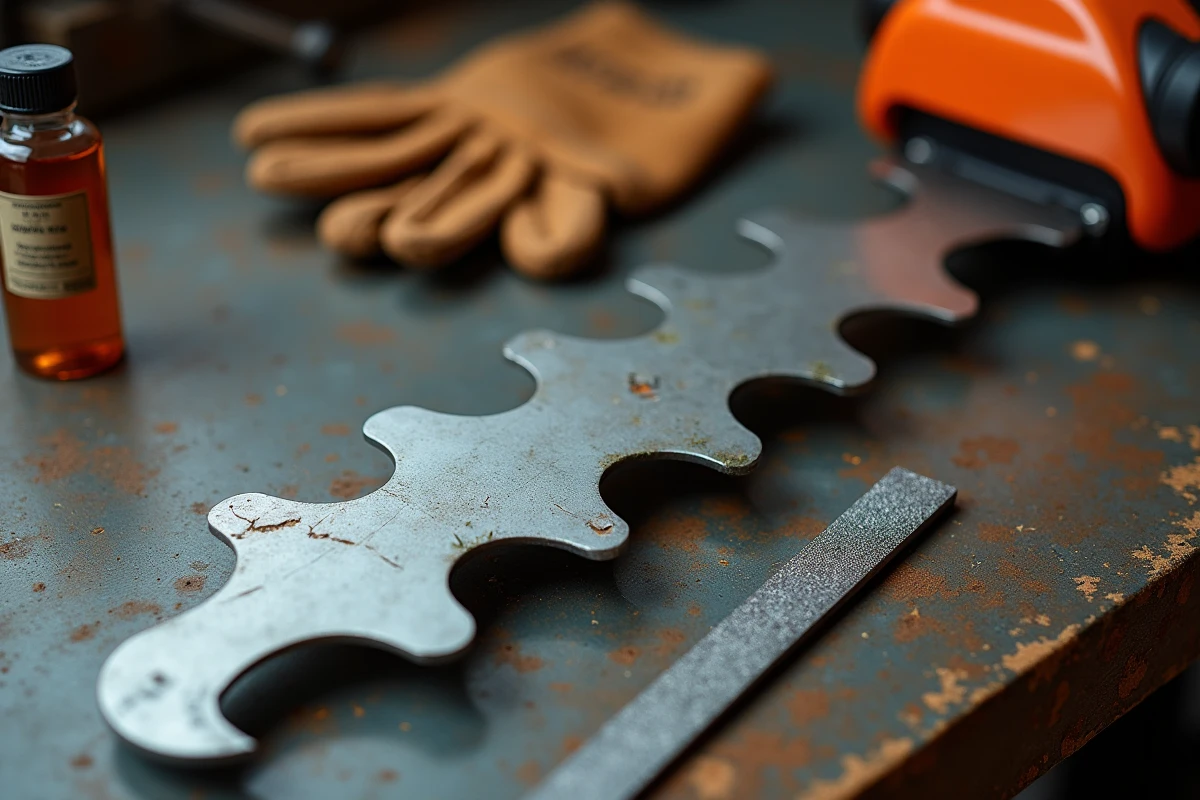
PPE and Vibration Protection During Sharpening
Sharpening tutorials generally mention safety glasses and protective gloves. Since the revision of the European directive 2002/44/EC on vibrations, manufacturers like Stihl, Husqvarna, and Echo go further: they recommend wearing anti-vibration gloves during repeated sharpening and usage operations.
The targeted risk is musculoskeletal disorders related to hand-arm vibrations. Sharpening with an angle grinder, repeated several times per season, exposes the hands to significant vibration levels.
- Anti-vibration gloves compliant with EN ISO 10819 standard
- Protective glasses against metal particle projections
- Hearing protection if sharpening is done with a noisy electric tool
- Vise or clamp to secure the blade (never sharpen a blade held by hand)
Securing the blade in a vise is a prerequisite, not an option. A blade that slips during a grinder pass can cause serious injuries.
Sharpening Frequency and Signs of Wear on the Blade
The frequency depends on the type of vegetation and the number of hours of use. Waiting for the cut to become clearly poor is already too late: at this stage, the blade has lost enough material for the balance to be compromised.
Visual Signs to Watch For
An edge that reflects light straight on has lost its sharpness. On grass, the tips of the blades appear torn rather than cleanly cut. A clean cut leaves a green blade, a torn cut leaves a white blade.
When to Replace Rather Than Resharpen
If deep notches or chips are visible on the edge, resharpening would remove too much material and unbalance the blade. A crack, even a fine one, requires immediate replacement: the risk of breakage during rotation cannot be managed by sharpening.
Regular maintenance of the blade extends the lifespan of the entire machine, not just that of the consumable. A sharp edge reduces the load on the clutch, shaft, and engine, which delays heavy mechanical interventions.