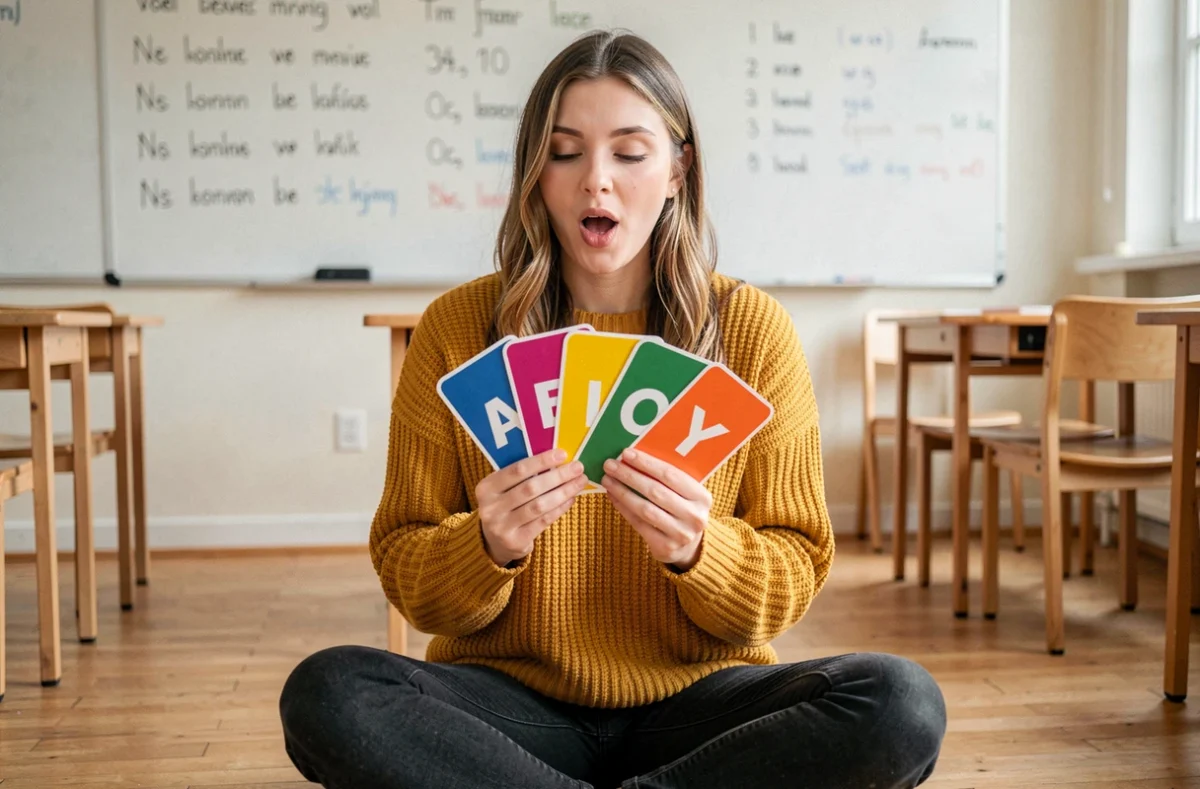
Learning the vowels A, E, I, O, U, Y is part of the first steps in reading. For a child in first grade or kindergarten, remembering six letters out of twenty-six may seem simple from the outside, but confusion with consonants can arise quickly. The following tips focus on play, gesture, and short repetition to anchor these six letters durably.
1. The face of the vowels: associating each letter with a part of the body
This tip circulates widely among teachers and parents. The principle: draw a simplified face and place each vowel on an element of the face that the child can touch.
- A and U correspond to the eyes: the child points to their two eyes while saying “A” then “U”
- E and Y correspond to the ears: they grab their ears while saying “E” then “Y”
- I corresponds to the nose: they touch their nose while saying “I”
- O corresponds to the mouth: they form a circle with their lips and say “O”
The multisensory approach (gesture, sight, voice) is now highlighted in recent educational resources. It goes beyond simple oral repetition by engaging multiple senses at once. When the child touches their nose for the I, they create a physical memory, not just an auditory one.
You can complement this method for learning the vowels by drawing the face on a sheet and letting the child color each area a different color.
2. The mnemonic phrase “Call Irène, she will open it for you”
Mnemonic devices work because they transform an abstract list into a concrete phrase. The phrase “Call Irène, she will open it for you” contains the six vowels in order: A, I, E, O, U, Y.
The child remembers a little story (someone calls Irène, who opens the door) rather than a sequence of letters. A phrase that tells a story is easier to remember than a dry list.
For younger children, you can adapt the phrase: “Ah, Émile, he dares a yo-yo party!” The idea remains the same. The first letters of each word, or the dominant sounds, remind them of A, E, I, O, U, Y. Let the child invent their own phrase: creating it further reinforces memorization.
3. Sorting letters with everyday objects
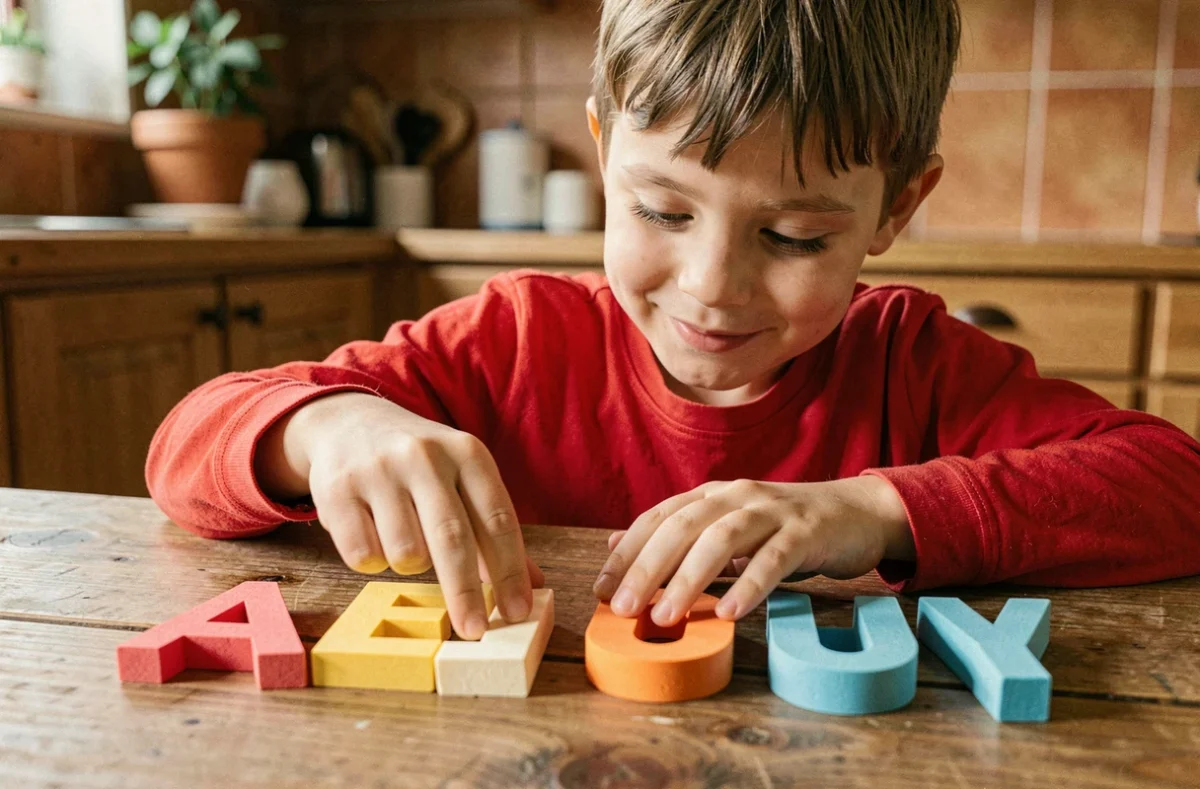
Take magnetic letters, marked bottle caps, or cut-out cards. Mix vowels and consonants, then ask the child to separate the two groups in under a minute.
This game works because it requires rapid visual recognition. The child does not recite the list: they must identify each letter and decide if it belongs to the vowels. Active sorting anchors the vowel-consonant distinction much better than passive recitation.
A detail often overlooked: include the Y in the mix. Many children forget that Y is a vowel in French. By systematically slipping it among the letters to sort, you avoid this classic oversight. If the child hesitates on the Y, it’s the perfect moment to discuss it.
4. The song to a familiar tune
Singing “A, E, I, O, U, Y” to the tune of “Au clair de la lune” or “Frère Jacques” transforms the list into a musical ritual. Recent educational resources recommend short daily sequences, lasting a few minutes each day, focused on manipulating sounds rather than naming the letters.
The melody creates an automatic response. After a few days, the child hums the vowels effortlessly. Five minutes a day is enough to establish a lasting phonological reflex.
A useful variation: sing the sequence while clapping hands at each vowel. The bodily rhythm adds an extra sensory layer. If the child makes a mistake, the rhythm breaks, signaling the error immediately.
5. The hidden vowel game in names
Take the names of family members or classmates. Ask the child to spot all the vowels in each name and count them.
With “Manon,” they find A and O. With “Émilie,” they identify E, I, I, E. With “Youssef,” they come across Y, O, U, E. This last example is particularly interesting: four vowels out of six appear in a single name.
The advantage of this game: it can be adapted to any moment of the day. In the car, in a waiting room, in front of a shopping list. No materials needed. The child learns to scan words to find the vowels, which directly prepares them for reading work in first grade.
6. The color code on everyday texts
Print a short text (nursery rhyme, simple recipe, book title) and give the child a bright colored marker. Their mission: to highlight all the vowels they find.
This activity works on phonological awareness through the visual channel. The child goes through each word letter by letter and must engage their knowledge of the six vowels at every moment. The official bulletin of 2024, effective from the start of the 2025 school year, specifically emphasizes these skills of segmentation and manipulation of phonemes at the end of the Grande Section.
To make the game more challenging after a few sessions, assign a different color to each vowel: red for A, blue for E, green for I, yellow for O, purple for U, orange for Y. The child must then not only spot the vowel but also choose the correct marker. The deliberate slowdown this causes reinforces the precise identification of each letter.
These six tips share a common point: they take learning out of the “recite and repeat” framework. A child who touches their face, sings, sorts bottle caps, or highlights a text is not just memorizing the vowels A, E, I, O, U, Y. They are manipulating them, and it is this active manipulation that transforms a list of letters into solid knowledge.