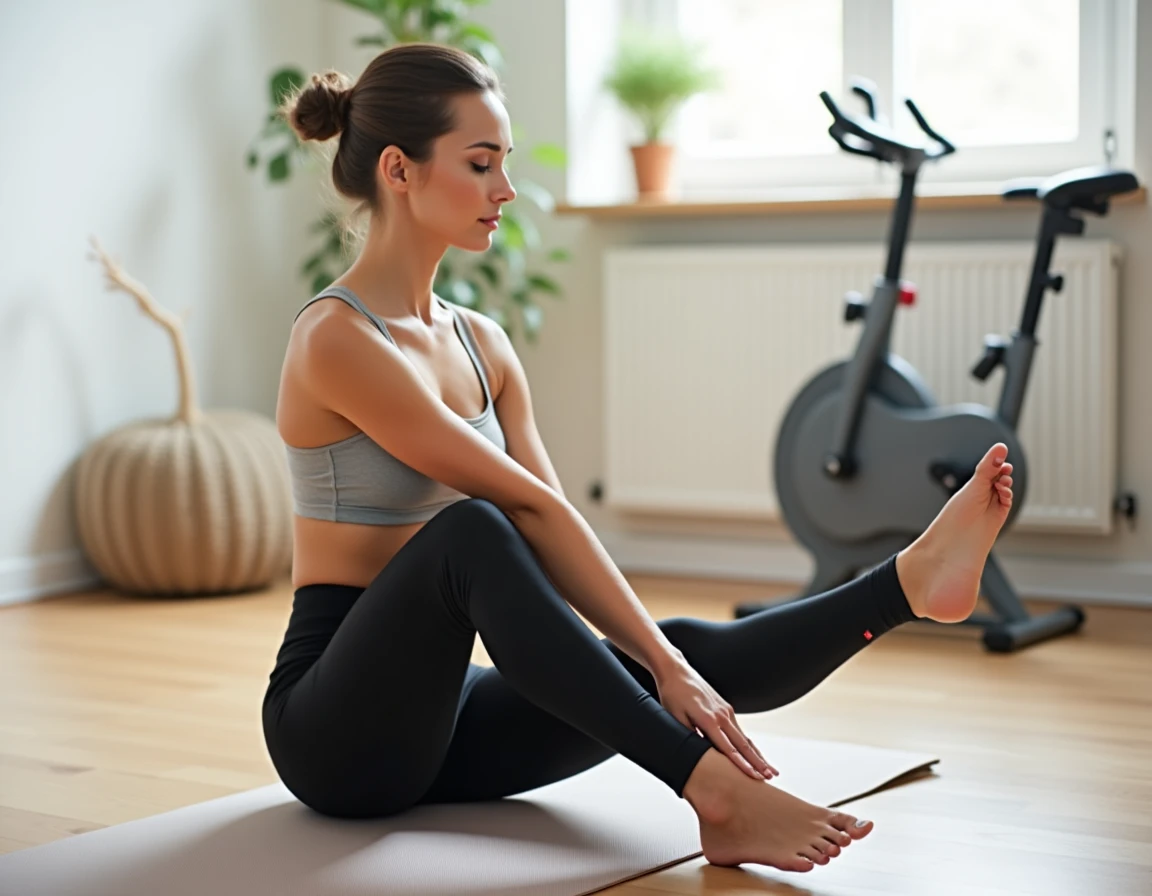
Pedaling on a stationary bike engages the lower limbs in a cyclic movement, with a joint range limited by the seated position. The quadriceps, hamstrings, calves, and hip flexors work in repeated shortening without ever reaching their maximum length. Practicing stretches after using the stationary bike helps restore this range and relieve the tensions accumulated during the effort.
Dynamic mobility or static stretching: what to do right after exercise
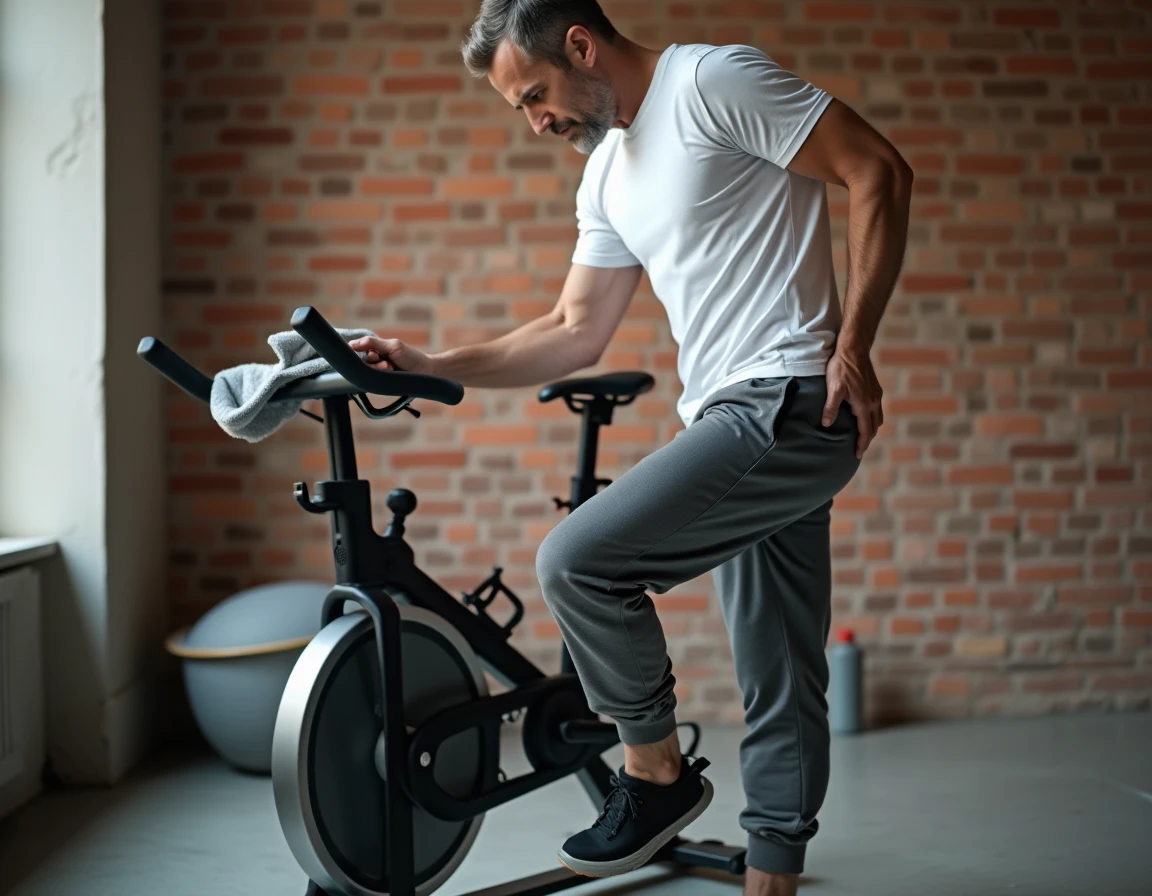
Most articles on the subject directly follow with a list of static postures to hold. However, several physiotherapists and fitness trainers recommend a two-step approach that is more respectful of neuromuscular recovery.
In the minutes following the session, favor short active mobilizations: controlled hip swings back and forth, ankle flexions-extensions, gentle spinal rotations. These movements gradually bring the muscles back to their resting length without creating excessive strain on still congested fibers.
Long static stretches (beyond twenty seconds per posture) are better suited for sessions dedicated to flexibility, separate from training. Mixing the two approaches is not a mistake, but dynamic mobilizations offer a better compromise between muscle relaxation and preservation of recovery capacity. Detailing the stretches after using a stationary bike requires making this distinction before moving on to concrete exercises.
Targeted stretches for the lower body after using a stationary bike

Pedaling engages a limited number of muscle groups with high intensity. Three areas concentrate the majority of residual tensions: the front of the thigh, the back of the leg, and the hip region.
Quadriceps: releasing the front of the thigh
Standing, with one hand against a wall for balance. Grab your ankle and bring your heel towards your buttock, knee pointing towards the ground. Pulling in your buttocks and tilting your pelvis forward increases the sensation of stretch without compensating with an arch in the back. Hold the position for several deep breaths, then switch legs.
Hamstrings: releasing the back of the thigh
Sitting on the ground, one leg extended in front of you and the other bent, foot against the inside of the opposite thigh. Lean your torso forward while keeping your back flat, hands sliding along the extended leg. The goal is not to touch your foot, but to feel a moderate tension at the back of the thigh. Forcing the position compresses the lumbar discs without additional benefit for the muscle.
Hip flexors: the forgotten area of the indoor cyclist
The prolonged seated position on the saddle keeps the hip flexors in constant shortening. With one knee on the ground, the other foot placed in front at a right angle, push your pelvis forward. The sensation should be located at the front of the hip of the back leg, in the psoas-iliac area. This deep muscle, difficult to stretch otherwise, accumulates progressive stiffness in regular practitioners.
Calves: don’t neglect the gastrocnemius
Facing a wall, one leg extended back with the heel pressed to the ground, the other bent forward. Gently push your pelvis towards the wall while keeping the back heel anchored. Vary by slightly bending the back knee to target the soleus, the deeper part of the calf that is particularly engaged during the pushing phase of pedaling.
Back and shoulder stretches often neglected on a stationary bike
The upper body does not pedal, but it supports the bent position throughout the session. The trapezius, paravertebral muscles, and shoulders contract isometrically to stabilize the torso.
Spinal rotation on the ground relieves accumulated lumbar tension. Lying on your back, bring both knees towards your chest and then let them fall to one side, arms spread out in a cross. Keep your shoulders pressed to the ground. This movement decompresses the lumbar region and mobilizes the spinal rotator muscles.
For the shoulders and neck, slowly tilt your head to one side, ear towards shoulder, letting the opposite arm hang alongside your body. A gentle pull from the hand on your head amplifies the stretch of the upper trapezius. This simple gesture counterbalances the tension in the shoulders that instinctively rise towards the ears during effort.
Stationary bike and joint pain: adapting your stretches
The stationary bike is often recommended for people suffering from knee osteoarthritis because it offers a smooth and repetitive movement with low joint impact. Post-session stretches should follow the same gentle logic.
- Favor low-intensity stretches for the hamstrings, quadriceps, and calves, staying below the pain threshold
- Combine with light strengthening work (isometric contractions of the quadriceps, for example) to stabilize the knee joint
- Avoid postures that impose deep knee flexion under load, such as standing heel-to-buttock without support
Adapting the range to the day’s joint tolerance remains the rule. A more intense session on the bike justifies more gradual stretches, not more forced ones.
Frequency and duration of stretches after a bike session
The question of how much time to dedicate to stretching comes up consistently. A complete routine covering the six areas described above takes between five and ten minutes. Extending it beyond that does not yield measurable gains for a typical recovery session.
- After each stationary bike session: dynamic mobility followed by short static stretches on the most engaged muscle groups
- Once or twice a week, outside of sessions: more in-depth flexibility work with postures held longer
- In case of persistent stiffness in a specific area: prioritize targeting that area rather than going through a complete program
Consistency matters more than duration. Five minutes of stretching after each workout produce better results on overall flexibility than a long isolated weekly session. Muscles recover better when relaxation is integrated into the routine, not treated as an optional bonus.