Marseille soap is a highly valued product for its various uses and ecological trends. Due to its success, it has become the target of several fraudulent imitations. However, there is a legal regulation governing the term “Savon de Marseille,” but this is no longer sufficient to distinguish the real from the fake. Nevertheless, there are a few tips that will help you recognize the original product. Read on!
A unique composition
It takes just 4 ingredients in total to prepare a true Marseille soap. These are caustic soda for saponification, water, olive oil, and sodium. Manufacturers who often produce counterfeit versions add products to their preparation to speed up the hardening of the soap. Therefore, you will end up with more ingredients in the product than necessary.
Most of these additives are chemical products. Some also serve as preservatives for the soap, allowing it to last longer. The recipe for genuine Marseille soap does not include any preservatives. So, when you find ingredients other than the four mentioned, it is likely a counterfeit.
A genuine Marseille soap must also contain at least 72% vegetable oil. Furthermore, Marseille soap should not contain any coloring, which is a clue to spot the fake. Some manufacturers sometimes color their production to give it that natural green, brown, or beige appearance. So be cautious of products that display other colors; they cannot be called Marseille soap.
Since no fragrance is used during the preparation of the soap, you should not find any special scent in the product. When a soap emits a fragrance other than that of the oil used in its preparation, then it is not Marseille soap.
Other tips to recognize genuine Marseille soap
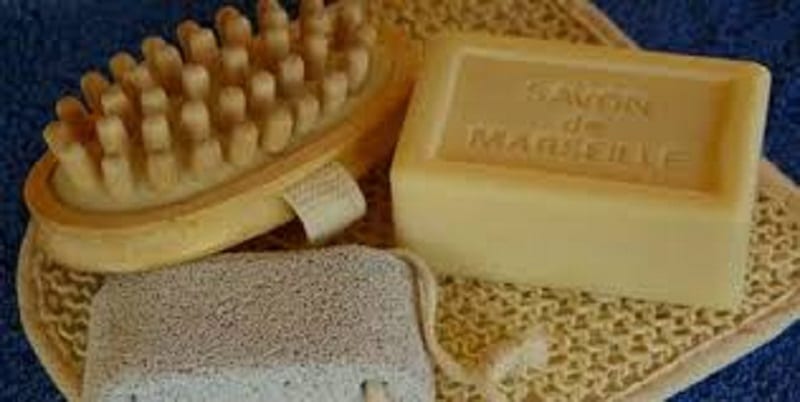
An important detail to recognize real Marseille soap in supermarkets is undoubtedly its distinctive cubic shape. You should then look for the mark that proves its authenticity, which is the stamp “Savon de Marseille.” This is a mark stamped on the soap.
The presence of this logo certifies that it is indeed the original soap that has followed the specific preparation steps according to the Marseille recipe. These include mixing, settling, cooking, washing, and liquidating.
There are several markings related to the name “savon de Marseille.” However, there is a specific marking that belongs exclusively to the union of Marseille professionals. When a soap bears this mark, it means that it is authentic.
On the other hand, you may find products with the mention of Marseille soap on the packaging. In this case, it is a fake. To respect its ecological goal, genuine Marseille soap is never packaged in retail shelves. The proportions of the ingredients are directly marked on the products by stamping.
Also, beware of prices that are too low. Due to ingredients like olive oil, the product can be expensive. You can find 500 g on the market for €4 or more.
Here are the various tips to determine an original Marseille soap.